
Fall 2025 EU Screening Tour – France Edition 1
From late September to early November 2025, screening events were held in France, Germany, and then France again.
The director had originally planned to attend, but due to extreme exhaustion during the summer that took a serious toll on his health, he was unfortunately forced to cancel. Instead, three members of the European team — Kurumi Sugita and Yuki Takahata (both based in France), and Yu Kajikawa (based in Germany) — handled everything from subtitle translation to coordinating the screenings and leading the post-screening discussions.
With the nationwide U.S. release scheduled for March 2026 approaching, we believe we were able to steadily establish meaningful activities in the EU as well. Thank you so very much.
Below is a report by Kurumi Sugita (reposted from Distant Neighbors 3.11 Facebook page).
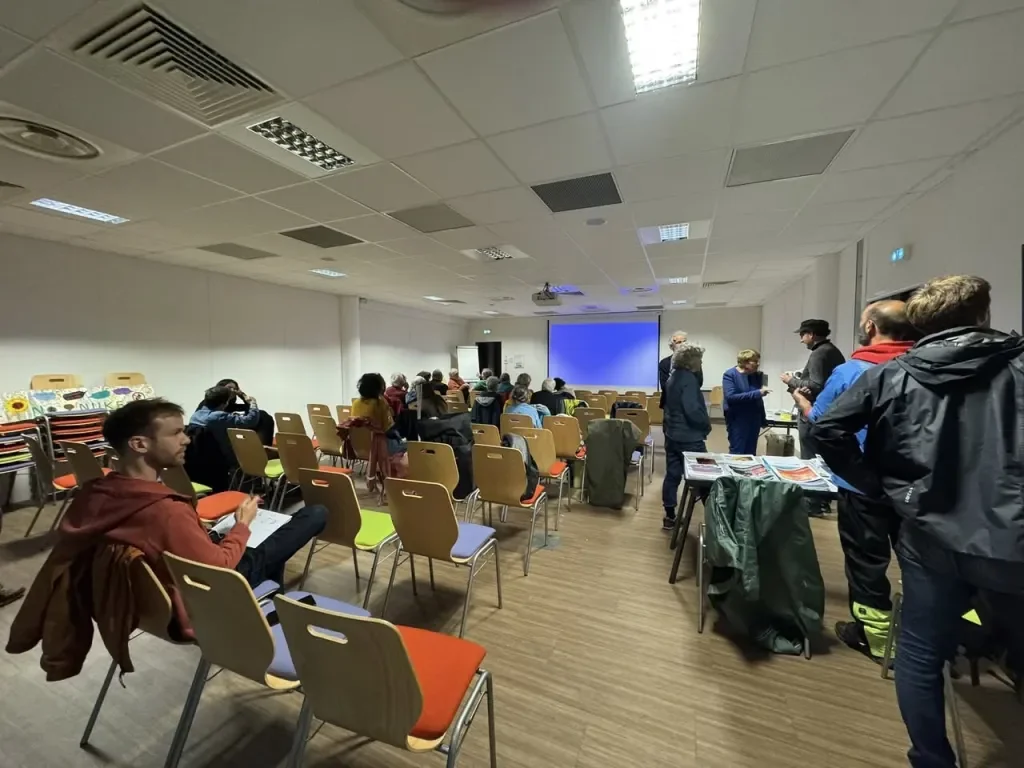
September 26, 2025
Lyon Metropolitan Environmental Center
September 26 is the International Day for the Total Elimination of Nuclear Weapons.
To mark this day, a screening of Silent Fallout was held at the Lyon Metropolitan Environmental Center.
France continues to face political instability, and the threat of global war feels increasingly real. Public opinion is often swayed by fear-driven rhetoric.
In such a climate, screening a film like Silent Fallout is not easy. Precisely for that reason, we felt strongly that it needed to be shown.
Attendance was approximately 30 people.
After the screening, an active Q&A session took place with Mr. Boubre from a citizen weapons-monitoring organization; Mr. Arakino, originally from French Polynesia, where many French nuclear tests were conducted, who is himself a nuclear victim and continues to share his testimony; and Sugita from Distant Neighbors 3.11.
Questions covered a wide range of topics, including:
The realities of French nuclear testing
Whether maps and data like those shown in Silent Fallout also exist regarding French nuclear tests
The current conditions and support available to nuclear victims in Polynesia
Reflections on the women who participated in the U.S. baby tooth survey
Whether similar baby tooth testing was conducted after the TEPCO Fukushima Daiichi nuclear accident (while nothing as large-scale as the U.S. study occurred, we shared information that analysis of Strontium-90 in cattle bones from Fukushima is currently being conducted in Austria)
The consistent pattern of information concealment seen across Hiroshima and Nagasaki, nuclear testing, and nuclear power plant accidents
The discussion was broad, in-depth, and highly engaged.
Afterward, participants gathered for drinks and light refreshments.
Many attendees expressed concern for Director Ito’s health and sent messages of encouragement to him.
Although Director Ito was unable to travel to Europe, the tour continued with screenings in Germany, and from October 11 onward, additional screenings resumed in France.
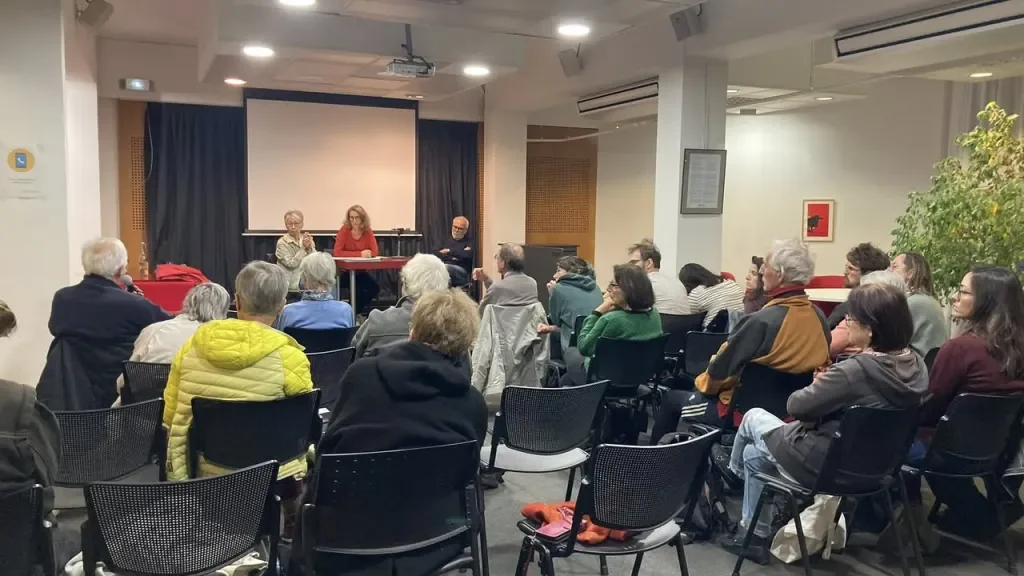
October 11, 2025
Grenoble Municipal Central Library
Here is a report from the Silent Fallout screening held in Grenoble on October 11.
The event was hosted by the Grenoble Central City Library.
Approximately 35 people attended.
The post-screening discussion was extremely lively, with some particularly sharp questions. For example, one asked whether differences in health effects between individuals with high levels of Strontium-90 accumulation and those with lower levels had been verified. I responded by referencing publications by Mangano.
One unexpected question was why Strontium-90 levels appeared to increase over time. I explained that as nuclear tests accumulated, Strontium-90 — which has a half-life of nearly 30 years — built up progressively in the environment.
As usual, many questions concerned French nuclear testing.
France conducted a total of 210 nuclear tests: from 1960 to 1966 in the Algerian desert, and from 1966 to 1996 in French Polynesia.
Support for victims in both Algeria and French Polynesia remains far from adequate. The situation in Algeria is particularly severe. While we are still able to hear the voices of nuclear victims in French Polynesia, voices from local residents in Algeria are rarely heard — largely due to political circumstances.
