Fall 2025 EU Screening Tour – France Edition 2
Following the last post, here is Part Two of the EU Screening Tour – France Edition, a report by Kurumi Sugita (reposted from Distant Neighbors 3.11 Facebook page).
October 13, 2025
Saint-Paul-Trois-Châteaux (Southern France) – Cinema Le Septième Art
Continuing the delayed report on Silent Fallout screenings in France.
On Monday, October 13, a screening was held at a cinema in the small town of Saint-Paul-Trois-Châteaux. This town hosts a nuclear power plant. The cinema venue is located just over 3 kilometers in a straight line from the Tricastin Nuclear Power Plant — incredibly close.
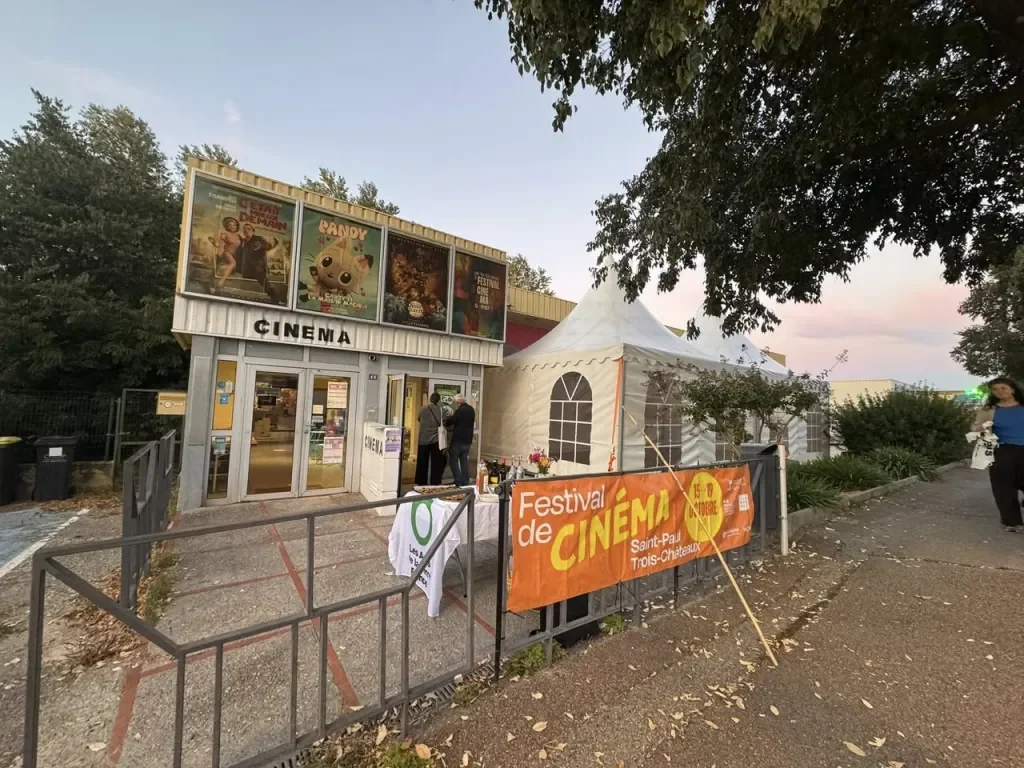
In towns with nuclear power plants, most residents tend to support nuclear energy, and there are very few anti-nuclear or anti–nuclear power advocates, which makes organizing and drawing attendance for events like this quite challenging.
At the small cinema venue, I spoke with the owner, who shared that young people have increasingly stopped going to the movies. This year in particular, attendance has been devastatingly low, and he believes the cinema will likely close by the end of the year. He mentioned that this is a nationwide trend.
The event began with an apéritif. The organizers had prepared homemade pies and other dishes, all of which were delicious. I was especially happy to see that there were always vegetarian options available at gatherings like this.
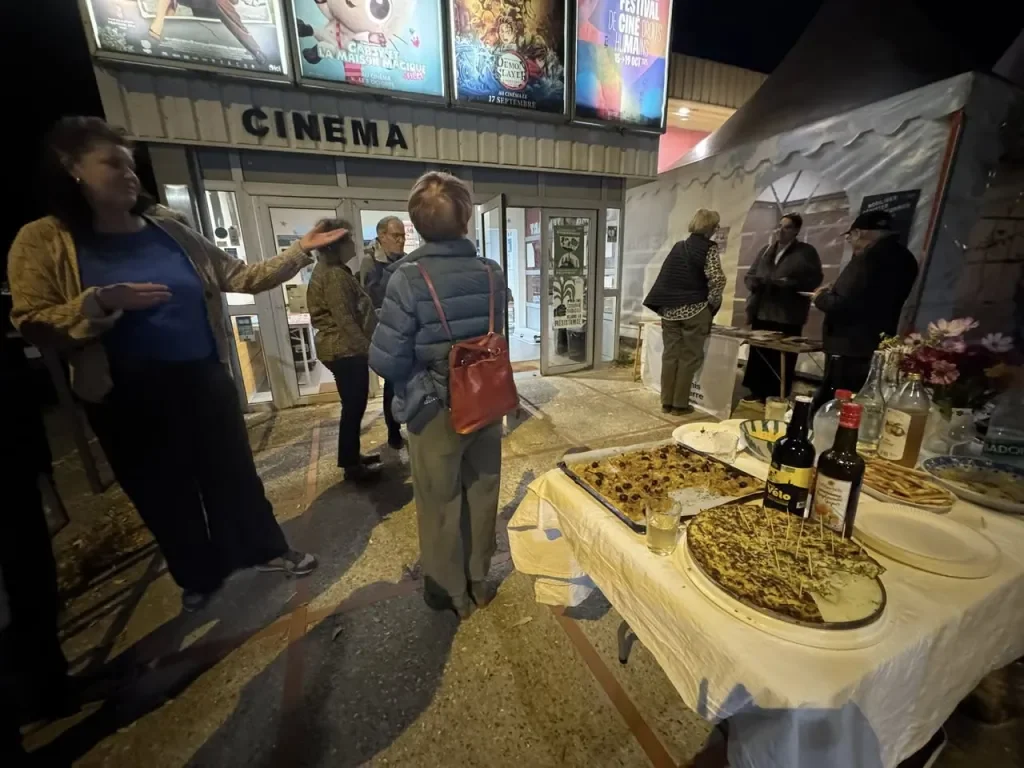
The organizing group was the local chapter of Friends of the Earth (FoE). Attendance was about 20 people.
Speaking at the post-screening discussion were myself; Mr. Debord from CRIIRAD (the Commission for Independent Research and Information on Radioactivity); and Mr. Malvaux from Stop Nuclear, active in this region.
One question that left a strong impression on me was whether breast milk or cow’s milk contains more strontium. I was slightly surprised, thinking, “Well… that’s actually the main theme of the film — did it not come across?” I assumed the concept of biological accumulation may not have been clear, so I added an explanation about radioactive environmental contamination and the food chain.
It also seemed somewhat unclear to some that the baby tooth testing was destructive analysis. Since the film includes scenes of baby teeth being taken out of envelopes, some viewers appeared not to realize that those particular teeth had not yet been analyzed.
There was also discussion about whether epidemiological studies were conducted after the atomic bombings, after nuclear tests, and after the Chernobyl accident — and about the quality of such studies. Regarding Japan, I explained the role of ABCC (Atomic Bomb Casualty Commission) and the Life Span Study (LSS), including the fact that their purpose was not treatment, but data collection for research related to the atomic bomb as a weapon.
In France, the term “nuclear testing” tends to evoke a clean, laboratory-like image, so some strongly argue that it should instead be called “nuclear explosions.” However, I believe that the word “testing” should not necessarily be removed, since both atomic bombings and nuclear tests treated local populations as experimental subjects — effectively as guinea pigs.
There were also questions frequently raised in Europe: If Japan experienced the atomic bombings of Hiroshima and Nagasaki, why did it accept nuclear power plants? And, as Europe is currently discussing the possible use of nuclear weapons, what is public opinion in Japan today regarding nuclear weapons?
Regarding the first question, I explained how the United States invested significant energy and funding to introduce nuclear power to Japan, including initiatives such as the “Atoms for Peace” exhibitions, and even proposals that were once considered in the U.S. to build a nuclear power plant in Hiroshima.
As for the second question, I spoke about Asia’s geopolitical situation, including North Korea’s most recent nuclear test in 2017, and the increasingly uncertain status of Japan’s Three Non-Nuclear Principles.
Another screening will take place nearby on November 28, in Montélimar, also close to the Tricastin nuclear power plant. It may again be difficult to draw a large audience, but I believe it is precisely in places like this that continuing to hold screenings carries real meaning.
October 18, 2025
Saint-Junien – “Foutez-nous la Paix” Festival
This report on the French screening tour of Silent Fallout is delayed, but on October 18 the film was shown in Saint-Junien, a town near Limoges in central France, as part of the festival Foutez-nous la Paix (which roughly translates to “Leave Us Alone!”). This was the sixth edition of the festival, and this year’s theme was “Japan.” The screening was included as part of the festival’s ten-day program.
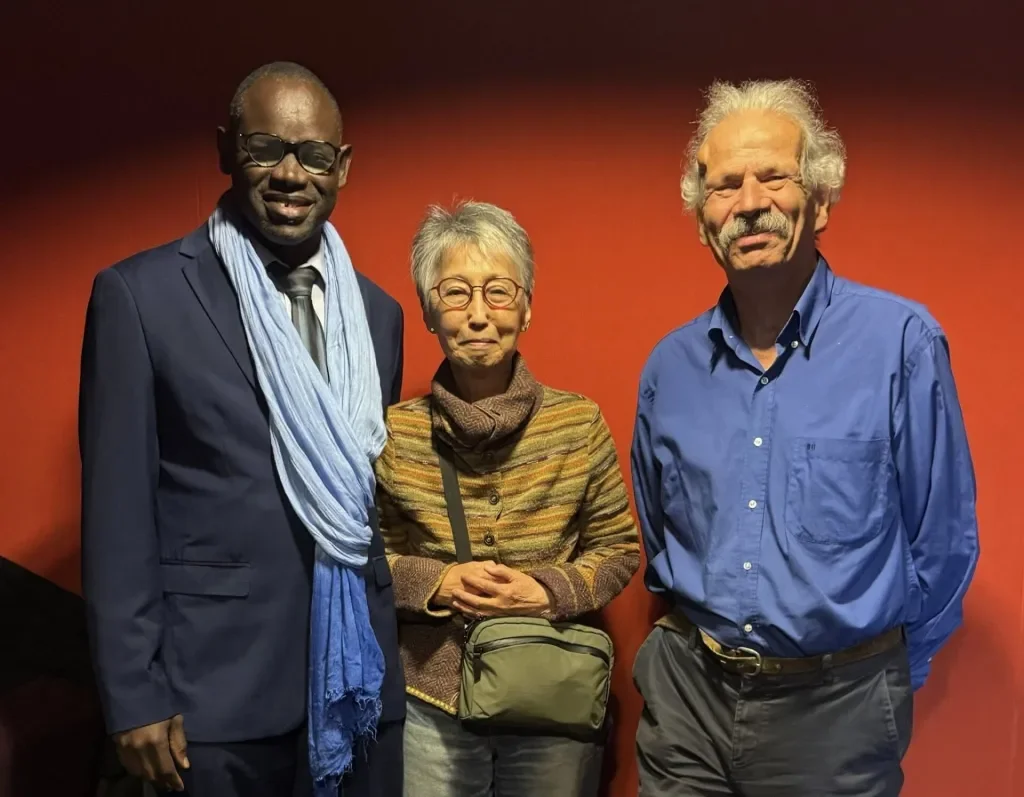
Attendance was around 30 people. The speakers were Patrice Boubre from a citizen weapons-monitoring group; Tiembele Guambayara, a journalist originally from Mali and now based in Paris; and myself.
One new question raised was: since so many baby teeth had been collected, couldn’t they have been used for an epidemiological study?
My response was that the baby tooth collection primarily functioned as a marker for measuring Strontium-90 absorption. Conducting an epidemiological study would require detailed long-term tracking of the donors’ life conditions and health outcomes. The program was not designed for that purpose, and it would not be feasible to repurpose the data in that way.
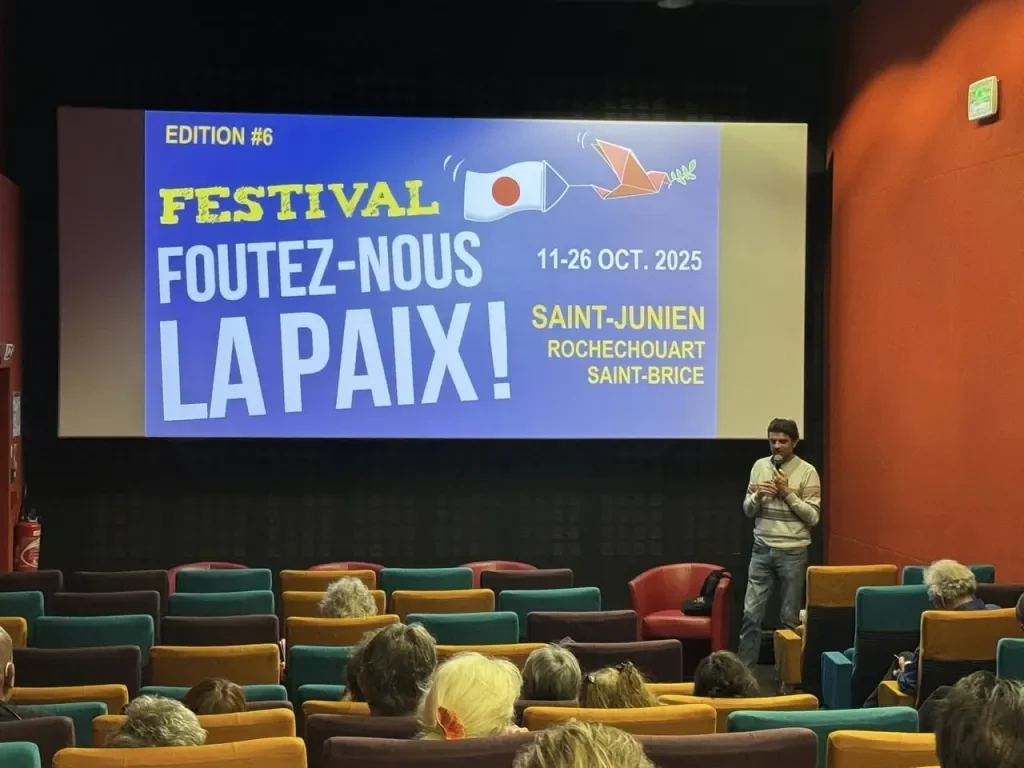
In addition, there were of course questions about French nuclear testing, the atomic bomb survivors in Japan, and the victims of the Fukushima accident. Mr. Arakino, a victim of nuclear testing in Polynesia, was present in the audience and spoke directly about the situation of Polynesian victims.
Due to political reasons, testimony from Africa is difficult to bring forward. However, Tiembele Guambayara explained that the issue of nuclear testing is not only Algeria’s problem. Fallout does not recognize national borders, and it is reasonable to assume that contamination has affected other countries as well. Yet when it comes to nuclear damage, Africa has become a “silent continent.”
Overall, including this screening, many people responded positively, saying, “We had no idea about these facts or about the baby tooth study. We were deeply moved.” We have also received several inquiries from people asking to organize screenings next year.
By the way, speaking of Limoges — it is also known for uranium mines.
Between 1946 and 2001, more than 200 uranium mines operated in mainland France. These activities generated vast amounts of radioactive waste, particularly mine tailings (approximately 200 million tons) and uranium extraction residues (over 50 million tons). Environmental contamination from this waste continues to this day.
There were uranium mines in northern Limoges as well, and this region produced one-third of France’s uranium.
Radioactive contamination, in its many layers, is not a distant issue in France — it is deeply embedded in its own history and landscape.